A practical guide to implementing Medallion Architecture in Microsoft Fabric — designed for SQL professionals transitioning into Lakehouse.
What is Medallion Architecture?
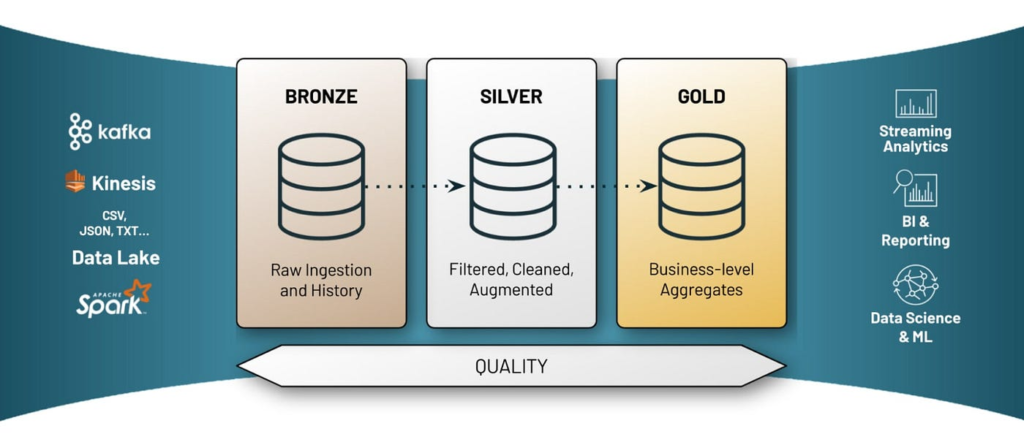
Medallion Architecture is a layered data design pattern used in modern Data Lake and Lakehouse platforms. It organizes data into progressively refined layers — typically Bronze, Silver, and Gold — improving data quality, structure, and usability at each stage.
Rather than transforming data in one large step, the Medallion approach promotes controlled, incremental refinement. This makes systems more scalable, testable, and easier to troubleshoot.
Bronze Layer — Raw Data Ingestion
The Bronze layer is the entry point of the system. It stores raw data exactly as it arrives from source systems.
Common characteristics of Bronze:
- Source-aligned schema (minimal transformation)
- Structured, semi-structured, or unstructured formats
- Additional metadata columns (load date, batch ID, source system)
- Append-only design
Bronze acts as your immutable historical archive. If downstream logic fails, you can always replay from this layer.
Silver Layer — Cleansed and Conformed Data
The Silver layer transforms raw Bronze data into validated, standardized, and conformed datasets.
Typical Silver transformations include:
- Data type corrections
- Deduplication
- Standardization of codes and formats
- Business rule validation
- Sensitive data masking
- Basic entity matching and merging
Silver provides a trusted enterprise-wide view of business entities such as Customers, Products, Stores, and Transactions.
In modern Lakehouse implementations, Silver data is often stored in Delta format, enabling ACID transactions, versioning, and performance optimization.
Gold Layer — Business-Ready Data Models
The Gold layer contains consumption-ready datasets optimized for reporting, dashboards, and business analytics.
This is where dimensional modeling techniques are applied:
- Star Schema design
- Fact and Dimension tables
- Surrogate key generation
- Aggregated reporting tables
Gold prioritizes clarity, performance, and business alignment. This layer feeds Power BI reports, executive dashboards, and analytical workloads.
Implementing Medallion Architecture in Microsoft Fabric
Microsoft Fabric is a unified SaaS analytics platform that brings together Data Engineering, Data Factory, Lakehouse, Warehouse, and Power BI in a single ecosystem.
Fabric naturally supports Medallion Architecture using:
- Lakehouse for Bronze and Silver layers
- Warehouse for Gold modeling
- Data Factory Pipelines for orchestration
- Apache Spark for transformation
- T-SQL for warehouse modeling
Lakehouse vs Warehouse in Fabric
Fabric Lakehouse provides Spark-based processing and Delta storage. Each Lakehouse automatically generates a SQL Endpoint, allowing T-SQL querying.
Fabric Warehouse provides a more traditional SQL-based modeling environment. It supports:
- Stored Procedures
- Views
- Cross-database queries
- Security policies
Although Warehouse feels similar to SQL Server or Synapse Dedicated Pool, its storage engine still relies on Delta files behind the scenes.
Why Medallion Architecture Works
- Clear separation of concerns
- Improved data quality control
- Easier debugging and replay
- Better governance
- Scalable design for enterprise systems
Final Thoughts
Medallion Architecture provides a structured pathway from raw ingestion to business-ready analytics. It aligns naturally with modern Lakehouse systems and is especially powerful when implemented inside Microsoft Fabric.
For SQL professionals transitioning into modern data platforms, this pattern offers familiarity while embracing scalability and flexibility.
- Bronze → Raw, immutable data
- Silver → Cleaned, standardized enterprise view
- Gold → Business-ready dimensional model
- Fabric enables implementation using Lakehouse + Warehouse