What Is OpenClaw and Why It Matters in 2026?

Artificial Intelligence has spent the last three years answering questions. In 2026, the conversation has shifted dramatically. The biggest trend is no longer AI chatbots. It is AI agents. Among dozens of agent frameworks that appeared over the last year, one project has emerged as a defining force in the open-source ecosystem: OpenClaw. OpenClaw is not just another AI tool. It represents a fundamental shift from AI that talks to AI that acts. What Exactly Is OpenClaw? OpenClaw is an open-source AI agent platform that allows Large Language Models (LLMs) such as GPT, Claude, Gemini, DeepSeek, and local models to… Read more


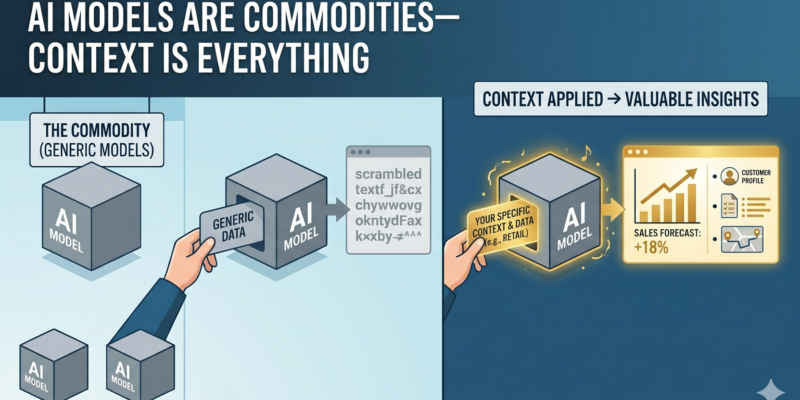
AI Models Are Commodities—Context is Everything

Over the last few years, access to powerful AI models has become increasingly democratized. Vendors are multiplying, release cycles are accelerating, and capabilities are converging. This leads to a critical question: If everyone has access to the same tools, where does the competitive advantage come from? I don’t believe the answer is the model itself. I believe the answer is context. The Commoditization of AI Not long ago, having access to advanced AI capabilities was a significant advantage. Today, the landscape looks very different. Organizations can access powerful models through APIs, cloud platforms, local deployments, and open-source alternatives. The gap… Read more


Hosting Local LLMs for Utility Tasks-When Smaller, Private Models Win

I feel like in the near future, every developer will have their own local LLM sitting right alongside their environment—just like how we all have VS Code, Visual Studio, or SQL Server Management Studio today. As data architects and developers, we’re often tempted to throw the biggest, most powerful API at every text-processing problem we encounter. Need a resume parsed? Call Claude. Need a user query categorized? Hit GPT-4. But when you’re processing thousands of documents, building high-volume automation pipelines, or handling proprietary application logs, relying entirely on external APIs introduces three major headaches: Spiraling token costsNetwork latency spikesData privacy… Read more


Most AI Products Don’t Fail at the Idea Stage

Lately, I’ve been hearing this a lot in corporate conversations: “We built an AI POC.”“We automated this with AI.”“Our AI demo was successful.” And honestly, many of them are successful at the POC stage. The models work.The demos look impressive.The presentations create excitement. But very few actually make it all the way to production and become part of real business operations. I think that’s one of the biggest gaps in the AI space right now. Not building the demo.Not proving the concept.But actually shipping something reliable, scalable, and usable in the real world. The demo environment is controlled.Production is not…. Read more


AI Guardrails — The Thing Nobody Thinks About Until It’s Too Late

In the last post, we talked about what AI agents are — systems that can reason, plan, use tools, and take real actions in the real world. Powerful stuff. Now here’s the uncomfortable follow-up question: what happens when an agent does the wrong thing? It sends an email to the wrong person. It runs a query that locks your production database. It leaks a piece of data that should never have left the system. These aren’t hypotheticals. In 2025, a growing number of companies reported AI agents accessing systems they weren’t supposed to or allowing inappropriate data access. And this… Read more


MCP : Connecting AI to SQL Server – Direct Tables vs Stored Procedures

Every developer building an MCP server for SQL Server hits the same fork in the road within the first five minutes. Do you let the AI talk directly to your tables? Or do you route everything through stored procedures? It sounds like a small decision. It’s not. This single choice shapes the security of your data, the flexibility of your AI assistant, and how much you’ll trust the whole system six months from now. I’ve seen teams go both ways. I’ve seen both blow up. Here’s what I think after watching this play out across different projects. The Direct Table… Read more


How MCP Actually Works — A Practical Walkthrough

We covered what MCP is. Now let’s trace what actually happens during a real interaction — step by step. Key idea: MCP doesn’t decide what action to take — the model decides. MCP defines how requests are structured, transmitted, and safely returned. If you’re anything like me, knowing what something is only gets you halfway. You want to know how it works. What actually happens when Claude asks GitHub for your open issues? What messages get sent? What’s happening behind the scenes? The Two Layers of MCP MCP is built in two layers. The Transport Layer is how messages physically… Read more


What is MCP? A Simple Guide for Developers

If you’ve been anywhere near the AI developer world lately, you’ve probably seen three letters popping up everywhere: MCP. Maybe you saw it in a tweet. Maybe your coworker mentioned it. Maybe you saw it in some tool’s changelog. By the end of this post, you’ll understand what MCP is, why it exists, and why it actually matters to you as a developer. Just the stuff you need to know. Key idea: MCP standardizes how AI applications connect to tools and data — it solves integration, not intelligence. So… What Actually Is MCP? MCP stands for Model Context Protocol. It’s… Read more


Understanding Claude as an AI Assistant

Claude is often described as a conversational AI. This article looks at what it actually helps with during everyday work. Key idea:Key idea: Claude is at its best when used as a thinking companion — an AI that works alongside you to explore ideas, challenge assumptions, and refine your thought process. AI assistants have improved significantly in recent years. Instead of responding only to fixed commands, modern systems can interpret natural language and assist with structured tasks. Claude is one such assistant, designed for conversation and practical problem solving. Language Understanding Claude processes natural language with contextual awareness rather than… Read more


AI Evolution: From Chatbots to Autonomous Agents

AI has been evolving fast. At first, software followed strict instructions.Then came chat-based AI — systems that could answer questions and hold conversations. Now we’re entering the next stage: AI that doesn’t just respond… it works toward a goal. These systems are called autonomous AI agents. From Asking Questions to Delegating Work Tools like ChatGPT or Claude are powerful, but they still depend on a conversation loop: You ask → AI answers → You refine → AI updates You remain in control of every step. Autonomous agents change this completely. Instead of telling the system how to do something, you… Read more