Prompt Engineering Was Just the Beginning
Over the past two years, the AI industry has been obsessed with Prompt Engineering—learning how to ask Large Language Models (LLMs) the right questions to get the best answers.
But as AI systems become more capable, something much bigger is happening.
The industry is shifting from writing prompts to designing intelligent systems.
This new approach is called Loop Engineering.
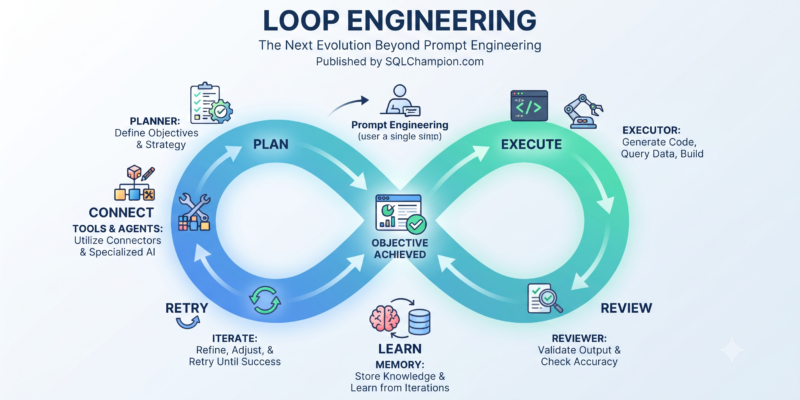
Instead of humans constantly guiding AI with carefully crafted prompts, developers are now building systems where AI continuously plans, executes, validates, learns, and retries until the objective is achieved.
The prompt is no longer the product.
The loop is.
What is Loop Engineering?
Loop Engineering is the practice of designing automated AI workflows where multiple AI agents, tools, and software components collaborate inside a controlled feedback loop.
Rather than executing a single prompt, the system repeatedly asks itself questions such as:
- Did I solve the problem?
- Is the output correct?
- Should I verify it?
- Should I retry?
- Do I need another tool?
- Do I need another AI agent?
The loop continues until predefined success criteria are met.
Think of it like hiring a team instead of a single employee.
One person plans.
Another writes.
Another reviews.
Another tests.
Another documents.
They keep collaborating until the work is complete.
Why People Say “Prompt Engineering is Dead”
You’ve probably seen headlines claiming that prompt engineering is becoming obsolete.
That’s an exaggeration—but there is some truth behind it.
Several AI leaders, including Jensen Huang, Andrew Ng, Boris Cherny, and Peter Steinberger, have discussed how modern AI development is moving beyond individual prompts.
Today’s AI systems automatically generate prompts, evaluate responses, and refine their own outputs.
Instead of asking:
“What prompt should I write?”
Developers now ask:
“How should my AI system think?”
That’s a fundamentally different engineering problem.
The Core Components of Loop Engineering
A production-grade AI loop is much more than an LLM API call.
It consists of several building blocks working together.
1. Planner
Determines what needs to be done.
Example:
“Build an HR dashboard.”
The planner breaks this into smaller tasks.
2. Executor
Performs the actual work.
Examples:
- Generate SQL
- Write Python
- Create documentation
- Query databases
- Search APIs
3. Reviewer
Checks whether the generated output is correct.
Questions include:
- Did the SQL execute?
- Did unit tests pass?
- Is the answer complete?
- Are business rules satisfied?
If not…
The loop continues.
4. Memory
AI models don’t truly remember previous sessions.
Loop Engineering introduces external memory:
- Vector databases
- Knowledge bases
- Wikis
- Project files
- Task history
- Previous conversations
Memory allows every iteration to become smarter than the last.
5. Skills
Skills are reusable instructions.
For example:
- How your company writes SQL
- Coding standards
- Naming conventions
- Deployment procedures
- Security guidelines
Instead of repeating these instructions every time, AI loads them automatically.
6. Tools & Connectors
Modern AI rarely works alone.
It connects to:
- GitHub
- Jira
- SQL Server
- PostgreSQL
- Power BI
- Slack
- Microsoft Teams
- Browsers
- REST APIs
- Cloud services
The AI decides which tool to use based on the task.
7. Sub-Agents
Instead of one giant AI doing everything, specialized agents collaborate.
For example:
- Planner Agent
- SQL Agent
- Documentation Agent
- Testing Agent
- Code Review Agent
- Deployment Agent
Each focuses on a single responsibility.
This makes the overall system more reliable and easier to maintain.
A Real Example
Imagine you’re developing a reporting system.
A traditional prompt looks like this:
“Write SQL to calculate monthly sales.”
You receive one answer.
You manually verify it.
You’re responsible for fixing mistakes.
Now imagine a loop.
The Planner creates the task.
↓
The SQL Agent writes the query.
↓
The Database Tool executes it.
↓
The Reviewer checks the results.
↓
If errors occur…
↓
The SQL Agent rewrites the query.
↓
The Reviewer tests again.
↓
The Documentation Agent explains the logic.
↓
The system commits the changes to GitHub.
All of this happens with minimal human intervention.
That’s Loop Engineering.
Enterprise Applications
Loop Engineering is already transforming enterprise software.
Software Development
- Generate code
- Run tests
- Fix failures
- Refactor code
- Update documentation
- Create pull requests
Business Intelligence
Imagine a Power BI environment.
A loop could:
- Detect KPI anomalies
- Query the warehouse
- Explain the cause
- Generate executive summaries
- Notify managers automatically
Instead of opening dashboards, executives receive insights proactively.
Customer Support
AI can:
- Read tickets
- Search documentation
- Draft responses
- Verify confidence
- Escalate uncertain cases to humans
Does This Mean Humans Are No Longer Needed?
Absolutely not.
AI can generate.
AI can review.
AI can retry.
But humans still define:
- Business objectives
- Architecture
- Security
- Compliance
- Guardrails
- Success criteria
The most valuable skill is no longer writing clever prompts.
It’s designing intelligent systems that know when to think, when to verify, and when to stop.
As AI becomes more autonomous, the engineer’s role evolves from operator to architect.
My Perspective
From my experience building enterprise AI systems, I believe Loop Engineering is not simply another trend or buzzword.
The real breakthrough isn’t adding more prompts.
It’s designing systems where planning, execution, validation, and continuous improvement happen automatically.
A well-designed architecture can often outperform a collection of clever prompts because it reduces errors, improves consistency, and scales more effectively.
In enterprise environments, success depends less on asking AI the perfect question and more on building workflows that can reliably deliver the right outcome—even when the first attempt isn’t perfect.
Final Thoughts
Prompt Engineering taught us how to communicate with AI.
Loop Engineering teaches AI how to work.
As AI systems become increasingly autonomous, developers will spend less time crafting individual prompts and more time designing intelligent workflows, orchestrating specialized agents, integrating business tools, and building reliable feedback loops.
The future belongs not to those who write the best prompt, but to those who design the best system.
Prompt Engineering tells AI what to do.
Loop Engineering builds AI systems that know how to get it done.
-Satya Katari
Thank you..