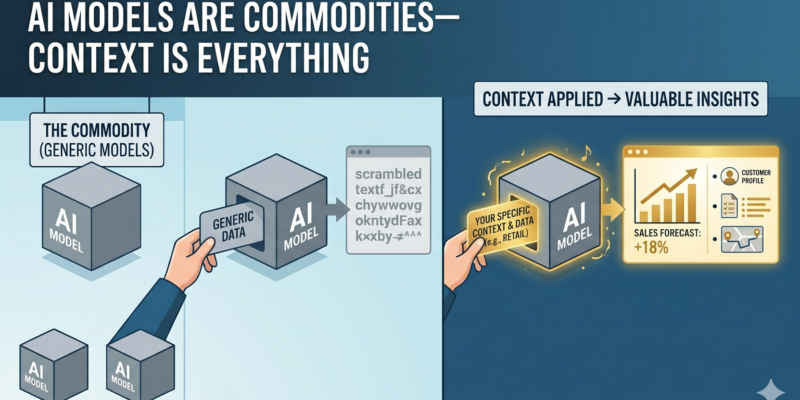
Over the last few years, access to powerful AI models has become increasingly democratized. Vendors are multiplying, release cycles are accelerating, and capabilities are converging.
This leads to a critical question: If everyone has access to the same tools, where does the competitive advantage come from?
I don’t believe the answer is the model itself. I believe the answer is context.
The Commoditization of AI
Not long ago, having access to advanced AI capabilities was a significant advantage. Today, the landscape looks very different. Organizations can access powerful models through APIs, cloud platforms, local deployments, and open-source alternatives.
The gap between companies is no longer determined by whether they have AI. The more important question is: What does the AI know about the business?
The Difference Between Information and Insight
A general-purpose AI model can answer questions about technology, science, finance, and countless other topics. However, business decisions rarely depend on general knowledge alone. They depend on context.
For example:
- Information: An AI system identifies that sales declined by 10%.
- Insight: A business-aware system identifies that sales declined because a high-performing product was unavailable in specific locations during a peak demand period.
The first answer provides information. The second provides insight. The difference is context.
Where Context Lives
Most organizations already possess enormous amounts of valuable context. It exists across:
- Operational systems
- ERP platforms
- CRM applications
- Data warehouses
- Historical transactions
- Business processes
- Policies and procedures
The challenge is not creating more data. The challenge is making that context available to AI systems in a meaningful way. For many organizations, the most reliable source of this context is already sitting in their relational databases, waiting to be queried by a well-prompted AI agent.
The Next Phase of Enterprise AI
Many current AI implementations focus on generating answers. The next generation of enterprise AI must focus on generating decisions and actions. That requires more than just a model; it requires:
- Access to business data: Real-time, trusted access to your specific data.
- Understanding of business rules: Awareness of how decisions are actually made within your organization.
- Awareness of operational processes: Integrating AI into the flow of work.
- System Integration: Embedding intelligence directly into your enterprise stack.
Without these elements, AI remains a useful assistant. With them, AI becomes a core business capability.
How Organizations Can Respond
Rather than focusing exclusively on model selection, organizations should invest in:
1. Building Context Layers
Create trusted, high-performance access to enterprise data, documents, policies, and operational systems.
2. Capturing Business Rules
Ensure AI solutions understand the unique logic and constraints that govern your decision-making processes.
3. Integrating Workflows
Embed AI directly into business processes rather than treating it as a separate, external tool.
4. Measuring Outcomes
Evaluate AI based on tangible business impact and ROI rather than model performance metrics alone.
Final Thoughts
The conversation around AI often focuses on which model is smarter, faster, or larger. I suspect that will become less important over time. Powerful models are increasingly available to everyone. Context is not.
The organizations that gain the most value from AI will not necessarily be those with the best models. They will be the ones that best connect AI to their unique data, processes, and business knowledge.
Thanks for your time.
-Satya Katari